Loading...

Loading...


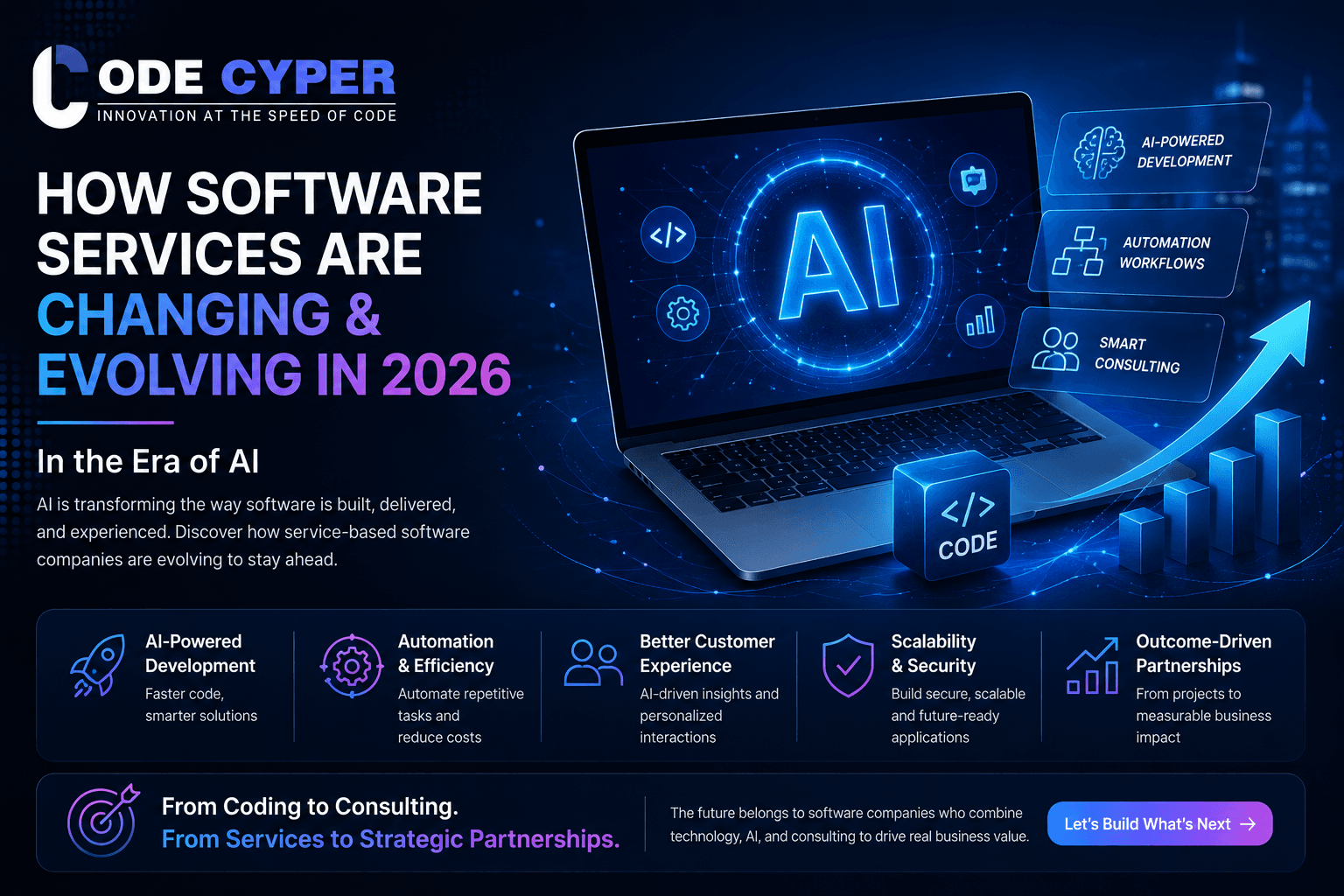
The software development industry is entering one of its biggest transformations yet.
For decades, software service companies operated around a relatively straightforward model: clients had a business requirement, development teams translated that requirement into technical specifications, developers wrote the code, QA teams tested it, and the company delivered the final product.
In 2026, that model is changing.

Artificial intelligence is now becoming part of almost every stage of the software lifecycle—from requirement analysis and architecture to coding, testing, documentation, deployment, maintenance and customer support.
AI coding agents are increasingly capable of inspecting repositories, generating code, running tests, debugging issues and creating patches.
But the biggest change isn't simply that AI can write code faster.
The bigger change is that clients are beginning to expect more business value from their technology partners.
And this is forcing service-based software companies to evolve.
Traditionally, many software development companies competed on:
This model worked well when software development was heavily dependent on human effort.
But AI is changing the economics of development.
A developer equipped with modern AI tools can increasingly accomplish tasks that previously required considerably more manual effort. This means the traditional measurement of value—such as billable hours, headcount and development capacity—is becoming less meaningful.
Recent reporting on India's IT sector highlights exactly this shift: AI is challenging the traditional relationship between revenue and employee headcount, while companies increasingly explore AI-related revenue streams and “services-as-software” models.
So the question for software companies is no longer:
“How many developers can we provide?”
It is becoming:
“What business outcome can we help you achieve?”
There has been considerable discussion about AI replacing developers and software companies.
But the reality is more nuanced.
AI can generate code.
AI can analyze information.
AI can automate repetitive tasks.
AI can test software.
AI can assist with debugging.
But successful software development still requires:
AI-generated code can also introduce security, quality and maintainability risks if it isn't properly reviewed and governed. Recent research is actively examining these trade-offs in real-world agentic software development.
This creates a major opportunity for service companies.
Instead of competing with AI, software companies can become the layer that makes AI useful, secure and practical for businesses.
The role of developers is also changing.
A developer's value will increasingly come from knowing what should be built, why it should be built, and how different technologies should work together, rather than simply writing every line of code manually.
Developers are increasingly working alongside AI coding assistants and agents.
This creates a new development workflow:
Business Requirement → AI-Assisted Planning → Architecture → AI-Assisted Development → Human Review → Testing → Deployment → Continuous Optimization
The developer becomes more of an engineer, reviewer, architect and problem solver.
This doesn't make technical skills less important.
It makes higher-level technical skills more important.
The most successful software service companies of the next few years will likely look very different from traditional development agencies.
Instead of simply offering:
“We provide developers.”
They will increasingly offer:
“We help you design, build, automate and continuously improve your technology ecosystem.”
That includes a combination of:
Custom web applications, mobile applications, SaaS platforms, enterprise applications and integrations will continue to be important.
But development will increasingly be AI-assisted.
Companies will need help implementing:
AI becomes significantly more valuable when it can take action, not just generate answers.
This is where automation and AI agents become important.
For example:
Customer question → AI understands intent → checks CRM → qualifies customer → creates lead → sends notification → schedules meeting
Instead of simply creating a chatbot, companies can build an intelligent workflow around the chatbot.
This is perhaps one of the biggest opportunities.
Clients don't necessarily need another company that simply writes code.
They need someone who can answer:
This is where software development and consulting begin to merge.
This is one of the biggest changes in the market.
Previously, a client might approach a software company saying:
“We need a CRM.”
Today, the conversation can be much broader:
“Our sales team is spending too much time following up with leads. How can technology improve this?”
The solution may involve:
CRM + AI + automation + analytics + integrations + workflow redesign.
The software company isn't simply building an application anymore.
It is helping redesign a business process.
That is a much higher-value relationship.
For service-based software companies, AI can actually create significant advantages.
AI-assisted development can reduce the time required for many repetitive coding and documentation tasks.
Ideas can be transformed into functional prototypes much faster, allowing businesses to validate concepts before committing to large development budgets.
AI allows experienced teams to increase their output without scaling headcount at the same rate.
AI tools can help developers understand legacy codebases, identify potential issues and accelerate debugging.
Lower development effort can make previously expensive custom software projects more accessible to small and mid-sized businesses.
AI can help teams analyze application usage, identify bottlenecks and recommend improvements after launch.
This is an important distinction.
Almost every software company can access AI tools today.
So simply saying:
“We use AI for development.”
is no longer a strong differentiator.
The real advantage comes from combining:
AI + Engineering Expertise + Business Understanding + Consulting + Domain Knowledge
That's where service companies can differentiate themselves.
The traditional model looked something like:
Client Requirement → Development Team → Software → Delivery
The emerging model looks more like:
Business Challenge
↓
Technology & AI Consulting
↓
Solution Architecture
↓
AI-Assisted Development
↓
Automation & Integration
↓
Deployment
↓
Analytics & Optimization
↓
Continuous Technology Partnership
This is a much more strategic relationship.
As AI makes software creation easier, deciding what to build becomes more valuable.
If everyone can generate an application quickly, the competitive advantage isn't necessarily the ability to create another application.
The advantage is knowing:
Which application should be created?
Which process should be automated?
Which data should be connected?
Which AI model should be used?
Where should humans remain in control?
How should the system be secured?
How will it generate measurable ROI?
This is where consulting becomes an essential part of modern software services.
Another important evolution is the movement away from purely time-based services.
Instead of:
“We will provide five developers for six months.”
the conversation increasingly becomes:
“We will help you automate this process, modernize this platform, launch this AI capability or improve this business workflow.”
The value is therefore connected more closely to the outcome rather than simply the number of hours worked.
This shift is already visible in the broader technology services market, including experiments with AI-powered platforms, recurring revenue models and “services-as-software.”
Businesses should look beyond a company's technology stack.
A strong technology partner should ideally understand:
Can they understand the problem behind the requirement?
Can they recommend the right architecture and technology?
Can they identify where AI genuinely creates value rather than adding AI unnecessarily?
Can they connect systems and automate workflows?
Can they design secure and reliable solutions?
Can the solution grow with the business?
Can they challenge assumptions and recommend better approaches?
Can they continue improving the system after launch?
The software company of the future won't fit neatly into one category.
It won't be purely:
A development company.
Or purely:
An AI company.
Or purely:
A consulting company.
It will combine all three.
Build the technology.
Make the technology intelligent.
Make sure the technology solves the right problem.
This combination creates a much stronger value proposition for businesses.
For traditional service-based software companies, 2026 should not be viewed simply as a threat.
It is an opportunity to reinvent the business model.
Companies that continue selling only development hours may face increasing pressure on pricing and differentiation.
Companies that evolve toward:
Consulting + Software Engineering + AI + Automation + Continuous Optimization
can move closer to becoming strategic technology partners.
The future isn't necessarily about having more developers.
It's about having better systems, better expertise and better use of AI.
AI is changing how software is designed, developed and delivered.
But technology alone doesn't create business value.
Businesses still need people who can understand their challenges, design the right solution, integrate different technologies, manage risk and turn ideas into reliable products.
That is why the next generation of software service companies will increasingly operate at the intersection of:
Technology + AI + Automation + Consulting + Business Strategy.
The companies that embrace this shift won't simply build software faster.
They will help businesses operate smarter.
And that is the real evolution of software services in 2026
Leave your details and any questions you have regarding this topic, and our experts will get back to you.